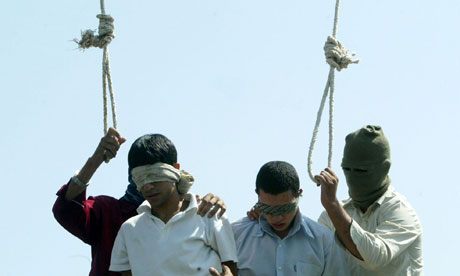
Last Thursday,
three men were hanged in Iran for the crime of lavat,
sexual intercourse between two men. The case is considered extreme even
by Iranian standards, because while the death penalty is in place for
homosexuality, it is usually enforced only when there is a charge of
assault or rape alongside it; the accusations in these three cases were
of consensual sex.
In Uganda, politicians have been seeking since
2009 to institute a strikingly nasty piece of legislation: the death
penalty for "aggravated homosexuality" (being homosexual more than once)
and, in a totalitarian touch, penalties for teachers, doctors and even
parents who suspected that someone in their care was gay but didn't
report them. In Belize, there is a law on the statute books that
criminalises homosexuality; a
gay rights
group in the country, Unibam, has brought a motion challenging the law,
and had this reply from the minister of works, Anthony "Boots"
Martinez: "My position is that God never placed anything on me for me to
look at a man and jump on a man. I'll be clear on it … How would you
decriminalise that, I am sorry, but that is law. Not only is the law
made by man, that is a law made from the Bible. Why you think God made a
man and a woman, man has what woman wants, and woman has what man
wants, it's as simple as that. I'll fight tooth and nail to keep that
law."
For lesbian and gay people who live in one of the 82
countries where homosexuality is criminalised, the world is not getting
better: it is getting significantly, demonstrably worse. The irony –
it's actually not an irony, it's a source of great shame, but it is also
an unhappy coincidence – is that 40 of these countries are members
of the Commonwealth, and this is a British export. Homosexuality was
criminalised here in the 1880s, and was therefore part of our
legislative package in the age of empire. By the time it was
decriminalised in England and Wales in the Sexual Offences Act of 1967
(Scotland followed in 1980 and Northern Ireland in 1982), we no longer
had any control over Commonwealth jurisdictions. The repeal came after a
report by Lord Wolfenden in 1957; if its findings had only been enacted
more swiftly, today unnumbered people across the Commonwealth – at an
estimate, more than a million – would be living entirely different
lives. Jonathan Cooper, CEO of the Human Dignity Trust, says: "The human
misery that criminalisation causes can never be overestimated. The
impact on lesbian and gay people growing up, you cannot overestimate
what it does to people living under those laws, even if they're not
being prosecuted. Just the fact that the rest of society is denied to
them, they have no access to it."
That's the bad news. Incredibly,
for a story like this, there is also good news. Apart from specific
campaigning bodies such as Stonewall and more general
human rights
agencies such as Amnesty, there is a new crop of organisations trying
to tackle this in a different way. This isn't another story about new
media taking on old battles, though an awe-inspiring
Facebook campaign, We Are Everywhere,
has gained ground since the hangings last week. But two groups in
particular are taking the old-fashioned routes of top-level pressure and
the rule of law.
Kaleidoscope
is described by its director, Lance Price, thus: "First, we're being
driven by the experience of the people in the countries we're talking
about. If you look at any country in the world where there has been
progress, it started with a small group of people who had the courage to
stand up. It's their struggle, these are their countries. Second, the
people involved have been active in politics at a very high level [Price
is a former adviser to Tony Blair], or active in the civil service at
a very high level. I'm not bragging. But we're working all the time on
behalf of people who struggle to have a voice, and we can bring them to
the attention of powerful people who do make decisions, in their own
countries and here."
It's not lobbying, exactly; it's not
diplomacy, but it is characterised by "quiet conversations with people
who can make a difference. We're going to have to engage with people,
quietly, rather than shouting at them."
The other group, the Human
Dignity Trust, is not a campaigning organisation either. It is not
there to raise awareness and is not even there to put pressure on
governments. It is setting out to change the law, in the Commonwealth
and beyond, on the basis that it is a breach of international human
rights to criminalise someone's sexual identity.
With a few
exceptions – Saudi Arabia being one – all the countries that criminalise
homosexuality are signed up to either the International Covenant on
Civil and Political Rights or they are bound by test case rulings in
their respective courts. "This is a matter of law," Cooper says. "Once
you're not following the law, you're undermining the rule of law." This
is reflected in the list of the trust's patrons – the former attorney
general of India; the former secretary general of the Commonwealth; Lord
Woolf, former lord chief justice of England and Wales; and a former
judge at the Intra-American court of human rights. "They are not
pursuing this as part of a lesbian and gay agenda. It's an international
rights law agenda," says Cooper.
The story of the trust is this:
when Uganda's homophobic upsurge began two years ago, Tim Otty, a QC
with a "strong sense of fairness" (according to his entry in Chambers
UK), was asked by the Commonwealth Association to give his advice on the
law, and found it, perhaps unsurprisingly, to be in breach of their
human rights treaty obligations. Cooper, also a barrister and a friend
of Otty, explains how the situation evolved: "Tim is pretty
establishment – he's at Blackstone chambers, he's not somebody you would
associate with lesbian and gay issues. Unlike me, because I've been
around these issues for 20, 30 years; I've done transgender cases, I've
done sexuality in the armed forces cases, I've done loads of this type
of stuff. So I was not at all surprised when, as we found out in our
research, 80-plus jurisdictions continue to criminalise homosexuality
around the world. That's almost half the countries in the world." He was
amazed that countries still criminalised in flagrant violation of
international human rights law, even having signed the treaty.
The
test case for European law was Jeff Dudgeon v the United Kingdom in
1981, when the activist brought a case against the British government
for the fact that criminalisation was still in force in Northern
Ireland. "In a way that was the revolution," says Cooper. "Human rights
now protected the lesbian and gay identity. But the Brits didn't
over-defend Dudgeon." If you are looking for excessive defence, that
happened in the Repulic of Ireland in the late-80s. "They threw
everything at this case, to say: you are not going to change our law,
human rights law cannot change Ireland's Christian-based law. The
Strasbourg court said: 'Actually, we can.'" After one more case, in
Cyprus, this became a settled matter for the Council of Europe. Then,
following a case brought by Nicholas Toonan in Australia in 1991, the
same decision was reached by the UN. "By the mid-90s, it had been
settled: international human rights law doesn't protect lesbian and gay
rights; it protects identity. And as a consequence of protecting
identity it protects you as a gay man or a lesbian woman from having
your identity criminalised. That's how it works," Cooper explains.
So
all the trust has to do now is change the world, through test case
litigation. It does so by finding an individual who is mounting a
challenge against, say, the government of Belize, and then, to put it a
layman's way, piling in. "I email our legal panel, asking: anyone have
any experience of litigating in Belize? Someone comes back and says
yeah, we'll represent you in this legal challenge. They bring in as
their counsel Lord Goldsmith, and the former attorney general of Belize,
Godfrey Smith. We turn up as the international community, with a
legitimate interest in the outcome of this case, but we do change the
nature of the struggle because we have approached it on the basis that
it's a major legal challenge. That is our intention." They're not going
to know what's hit them, I observe. "You almost feel sorry for the
judge!" Cooper replies, delighted.
Naturally, an appeal will be
mounted, whoever loses, and the case will then go to a higher court.
"What that means is that when we turn up in the difficult places of
Africa and Asia, it's watertight. You can imagine them saying: 'Well,
that's South Africa, that's the US supreme court' and trying to
distinguish them. But it would be very difficult to distinguish two
privy council decisions, one from the South Pacific, one from the
Caribbean. If you are that independent judge in Kenya, faced with those
authorities, how do you say: 'We're going to retain criminalisation'?
You can't."
Price is quite cautious about the work he's taken on:
he thinks the process will be slow, and its impact subtle. "If we can
just begin to level the playing field a bit so that the other side is
put, that will be progress. Because, at the moment, those who want to
preach hate have pretty well got a free run."
Cooper, also
measured but with the fire of optimism in his eyes, thinks they could
have all the decisions they need in five years. "We will have to pay for
cases in jurisdictions; I don't see why local lawyers should do it pro
bono. We will fundraise, and there is something rather charming that you
can say to somebody: 'If you give us £50,000, I can more or less
guarantee that you will have decriminalised homosexuality in Tonga.' And
actually, you know, that's great."
 One clear way of looking into representations of any particular group is to investigate media which specifically targets them. Diva is Europe's best-selling lesbian magazine, and there's a lengthy profile in today's Guardian of its editor, who relates some of the difficulties of editing such a title as well as some of the social changes she's seen in her time. Here's a few sample quotes; you can read the full article here.